
VASCULAR CENTER
Vascular & Endovascular Surgery
Carotid Artery Disease
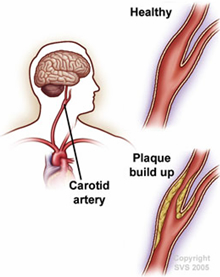 Most strokes occur when the blood supply to your brain is interrupted by deposits of plaque in the blood vessels that are caused by atherosclerosis. The two main arteries that bring blood to your brain are the left and right carotid arteries, on either side of your neck. When these arteries become hardened or narrowed by deposits of plaque, which is made from fat and cholesterol, you have a condition called cerebrovascular disease and risk having a stroke.
Some individuals who have cerebrovascular disease do not have any symptoms, but others experience TIAs (Transient Ischemic Attacks) or “mini-strokes.” TIAs are a warning sign, because if are they left untreated, many of these patients will later have a stroke. Initial strokes are fatal in 20 to 30% of individuals, so it is important be aware of the signs and symptoms of a stroke and know what your risk factors are (see below).
Atherosclerosis and cerebrovascular disease may not produce symptoms until more than two-thirds of a blood vessel is occluded (blocked) by plaque. However, the build up of plaque can interfere with smooth blood flow, causing tiny clots to form. Also, pieces of the plaque can break off, releasing emboli into the blood stream. A small clot or embolus in the blood stream can obstruct a blood vessel deeper into the brain, causing a stroke or TIA. Surgery is indicated when well over half of the artery is occluded (blocked), or when you have experienced a TIA. The surgical procedure to clean plaque from the wall of the carotid artery is called a carotid endarterectomy, or CEA. This surgery will improve the smooth flow of blood through your carotid arteries.
Causes of Cerebrovascular Disease
There are many risk factors for atherosclerosis. Making changes in your lifestyle or taking medications can reduce your risk.
Risk Factors for Atherosclerosis
- Cigarette smoking
- Diabetes
- High cholesterol or a high fat diet, or both
- Hypercoagulable states, which are blood abnormalities that increase the development of clots
- Hypertension (high blood pressure)
- Age over 60
- Family history
- Excessive alcohol use
- Sedentary lifestyle
Symptoms of Cerebrovascular Disease
Stroke. The symptoms of a stroke vary, depending on the location of the embolus or clot that cuts off blood flow in your brain. They usually involve a loss of motor and sensory abilities in the arms and legs. Often only one side of your body is affected: the side opposite the location of the clot or embolus. You may also experience slurred speech and drooping of one side of the face.
While symptoms of a stroke may heal over time, some deficits may always remain. It is also important to remember that even a first stroke can be fatal. Of those who survive a stroke, half will suffer another stroke.
TIA (Transient Ischemic Attack). Symptoms of a TIA include a short-term numbness or paralysis of an arm, leg, or both on one side of the body. These symptoms are caused by a small clot or embolus to the brain that blocks blood flow. By definition, any motor or sensory loss caused by a TIA will resolve in 24 hours or less. Common temporary symptoms include difficulty speaking or understanding others, loss or blurring of vision in one eye, and loss of strength or numbness in an arm or leg. Usually these symptoms resolve in less than 10 to 20 minutes, and almost always within one hour. Even if all the symptoms resolve, call 911 to be evaluated immediately.
Amaurosis fugax occurs when an embolus or clot travels to the ophthalmic artery and blocks blood flow there. This causes temporary loss of vision in the affected eye. The blindness usually begins in one quadrant of the eye and progresses until all vision is lost. Vision is restored in the same pattern.
Diagnosing Cerebrovascular Disease
Carotid Bruit. Even if you have no symptoms, your doctor may detect cerebrovascular disease by the presence of a carotid bruit. This is an abnormal sound heard with a stethoscope placed over the carotid arteries in the neck.
Carotid Duplex Ultrasound. An ultrasound of the arteries in the neck can show the presence of stenosis, or narrowing of the carotid arteries due to the buildup of plaque. This painless test is done in the office while you are awake.
Cerebral and Carotid Arteriogram. During this procedure, dye is injected into an artery and an X-ray is taken as it travels up through the arteries in the neck and into the brain. This test allows the doctor to see exactly where vessels have narrowed. The procedure is done in a sterile environment while you are awake, and it may take several hours, so empty your bladder before it begins. There may be some discomfort when the IV is started, but it is generally a painless procedure.
Treating Cerebrovascular Disease
Non-Surgical
There are some non-surgical interventions that can help you manage this disease and lower your risk for TIAs, stroke, and other adverse effects of atherosclerosis. Some of these measures include:
- Taking drugs such as aspirin and Plavix to prevent cells in the blood from sticking together and thus decrease the risk of forming a dangerous clot.
- Getting treatment for diseases like high blood pressure and high cholesterol, and properly managing diabetes, can all help lower the risk of cerebrovascular events.
- Smoking cessation. This is a critical step in lowering your risk of a TIA or stroke because the chemicals in cigarette smoke damage the lining of your arteries. It is also important for the healing of damaged tissues.
When atherosclerosis has damaged your carotid arteries, it has likely also affected blood supply in other parts of your body, such as your coronary and femoral arteries. Thus you may also be at risk for a heart attack and peripheral vascular disease. Check with your doctor to see if you should have additional screening done.
Surgical Treatment
Carotid endarterectomy (CEA) is a surgical procedure used to remove plaque deposits inside of an artery.
An incision is made in the neck to expose the carotid artery. The surgeon clamps the carotid on both sides of the plaque deposit to prevent bleeding. Vessels from the other side of the body take over to supply the brain with blood during the operation. The surgeon opens the vessel and pulls out the plaque. In most cases, a sterile patch is sewn to each edge of the artery to help keep the artery open and prevent plaque from forming again. The surgeon closes the artery. Once all bleeding is controlled, the muscles and tissues in the neck are sewn together and the skin is closed.